Replacing eggs in vegan cooking is one of the most important techniques to master. There are two ways to do it: through individual ingredients that mimic the same functions, or through ready-made commercial products designed specifically for the job.
I have written a comprehensive guide covering everything you need to know about vegan egg substitutes in vegan cooking, what eggs actually do in a recipe, which natural substitutes work for each function, and exact quantities for every use case. If you want to understand the fundamentals, start there.
In this article we focus specifically on commercial solutions: the ready-made vegan egg substitute products available on the market, how to use them, and, just as importantly, when they are worth reaching for and when they are not.
The Vegan Egg Substitute Market: What Is Available and What to Look For
The global vegan food market is currently valued at between 24.5 and 24.7 billion dollars, and according to Grand Review Research is projected to reach 52 billion dollars by 2033, growing at approximately 11% per year. These are significant numbers.
When I was twenty, I remember that finding tofu or tempeh was a genuine challenge. There were no dedicated vegan sections in supermarkets, and the small independent shops that carried these products were struggling to survive. Things have changed. They are still changing. The revolution is already underway.
Products designed to replace eggs are now abundant, varied in format, widely available, and increasingly clean in their ingredient lists despite being industrially produced. My personal advice is always to cook with as few processed products as possible. But experimenting is part of the joy of cooking, and when you do reach for a ready-made solution, the key is to look for products that are as minimally processed as possible.
For eggs, there are several types of ready-made substitutes. For a deeper understanding of which substitute works best for which function, refer to our complete guide to replacing eggs in vegan cooking. Here, we focus exclusively on the ready-made commercial options.
Liquid Vegan Egg Substitutes: Ready to Pour, Ready to Use
Liquid egg substitutes are the closest thing to opening a carton of conventional eggs: same format, same gesture, minimal adaptation required. They are ideal when you want immediacy: no measuring powders, no mixing, no waiting. You shake, pour and cook.
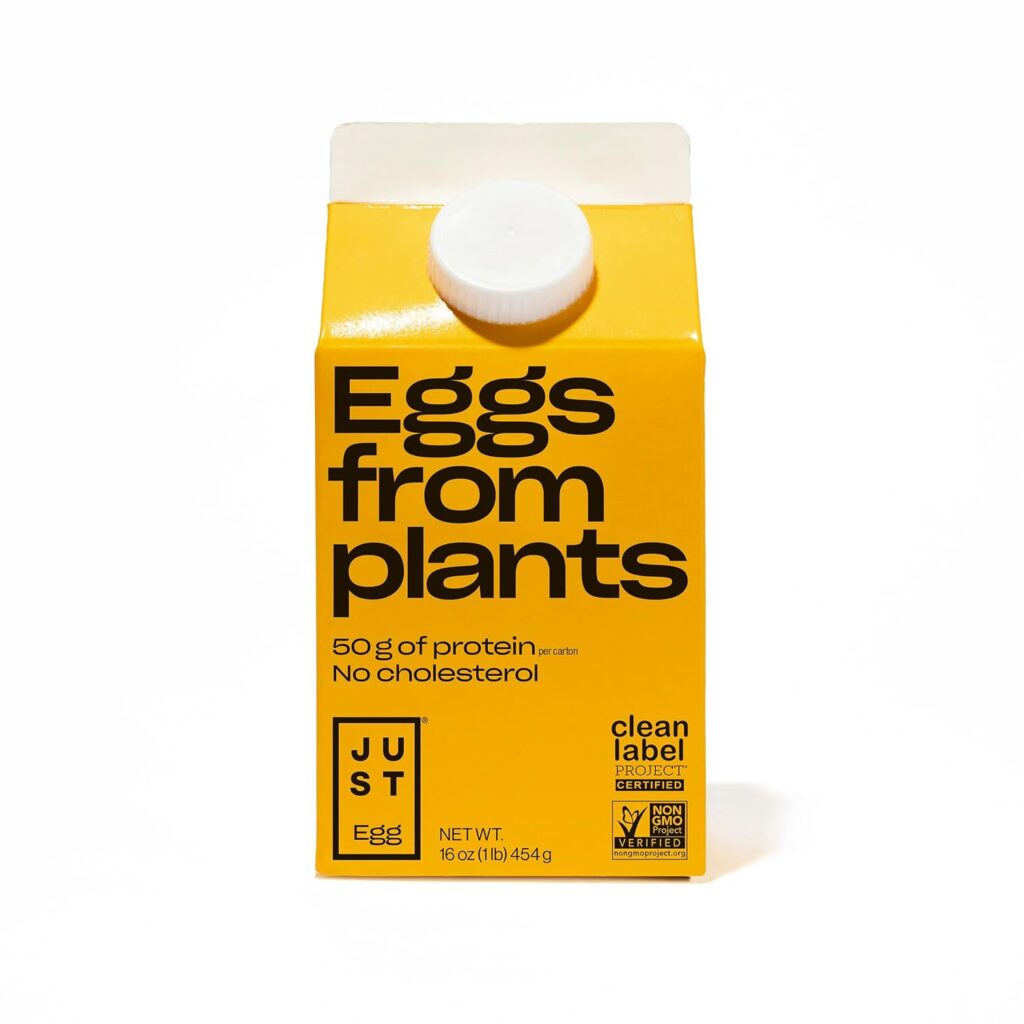
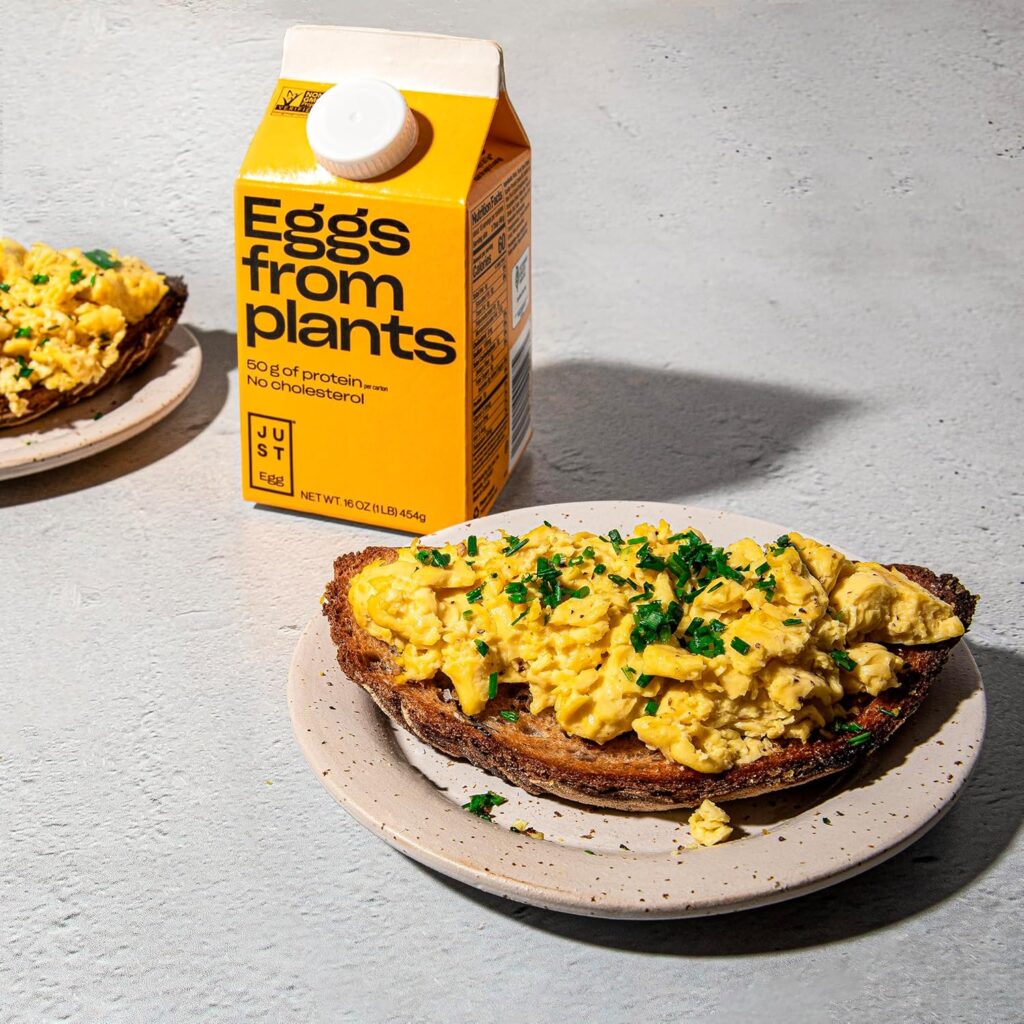
Just Egg — The Liquid Vegan Egg That Changed Everything
Just Egg is probably the most well-known commercial vegan egg substitute on the market, and for good reason. Made by the American company Eat Just, it comes in a recognisable yellow bottle and is based on a surprisingly ancient ingredient: the mung bean, a legume that has been cultivated for over 4,400 years across Asia and the Indian subcontinent.
The main ingredients are water, mung bean protein isolate, and expeller pressed canola oil, with small amounts of turmeric and carrot extract for colour, and soy lecithin as an emulsifier. The ingredient list is longer than you might hope for, this is an industrially processed product and it reads like one. That said, it contains no cholesterol and has a decent macronutrient profile, which puts it ahead of conventional eggs on certain nutritional metrics.
Just Egg comes in three formats: the original liquid egg, folded egg patties ideal for sandwiches, and breakfast burritos. For our purposes, the liquid version is the most relevan: it is the one designed to replace eggs in cooking and baking.
WHAT IT DOES WELL
Scrambled eggs, omelettes, frittatas and quiches. The liquid version can replace chicken eggs in a one-for-one swap in many culinary applications. Use 3 tablespoons per egg.
WHAT IT DOES NOT DO
It does not replicate egg whites for whipping, for meringues and mousses, aquafaba remains your best option.
HONEST NOTE
I have not personally tested Just Egg yet, it is not widely available outside US. But the community feedback is consistently strong, and the science behind mung bean protein as an egg replacer is solid.
The VERY food co. Aquafaba — The Cleanest Commercial Egg White Substitute
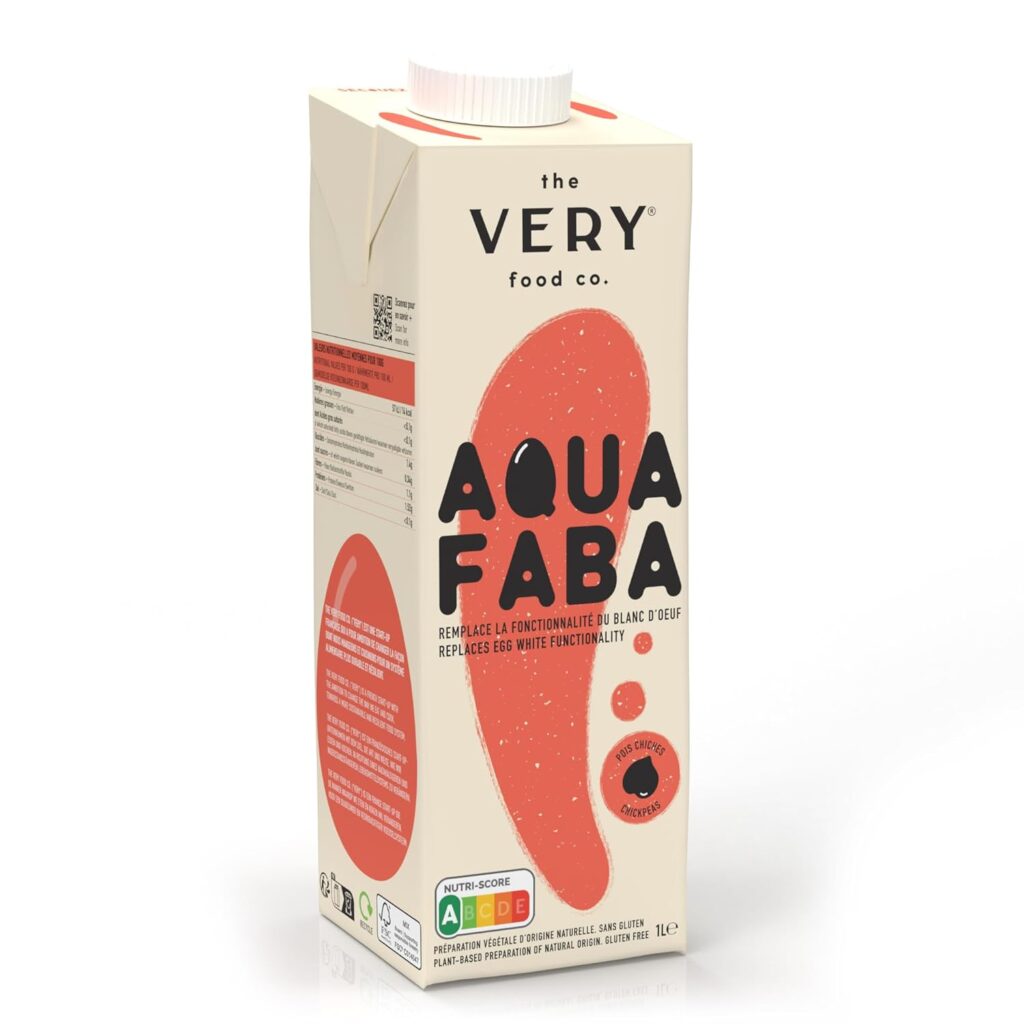
While Just Egg is designed to replace the whole egg, The VERY food co. Aquafaba does something entirely different: it replaces the egg white. Specifically, it is a ready-to-use commercial version of aquafaba, the chickpea cooking liquid we covered in depth in our complete guide to egg substitutes. The difference here is convenience: instead of draining a can of chickpeas every time you need it, you open a carton and pour.
Made by a German brand and available also on the US Market, it contains exactly two ingredients: water and chickpeas. That is it. No additives, no preservatives, no stabilisers. Just chickpea water, bottled and ready to use, which makes it one of the cleanest ingredient lists of any commercial egg substitute on the market.
The 1 litre format is designed primarily for professional use, but it works perfectly well for home bakers who use aquafaba regularly and want a consistent, ready-to-use supply without draining can after can of chickpeas.
WHAT IT DOES WELL
Meringues, mousses, mayonnaise, pancakes, cocktails: everything aquafaba does well, with complete ingredient transparency.
WHAT IT DOES NOT DO
It cannot replace eggs for scrambling or cooking, for that, you need other products.
MY HONEST REVIEW
Since I use chickpeas extensively, I tend to reach for the cooking liquid or the water from the can.But I have tried this product and it works perfectly. It is particularly useful for avoiding waste when you do not have a specific reason to cook chickpeas.

Powdered Vegan Egg Substitutes: The Science of the Long Shelf Life
Powdered egg substitutes work on a different principle than liquid ones. Rather than replicating the physical form of an egg, they deliver the functional components in concentrated, dehydrated form, typically a combination of starches, plant-based proteins, and leavening agents that, when rehydrated, behave similarly to egg proteins in a batter or dough.
The science behind them is straightforward: during dehydration, the water is removed from the base ingredients while the proteins and starches remain intact. When you add water back, these molecules rehydrate and begin to form the same networks they would in a fresh egg: binding, trapping air, or thickening depending on the formulation. The result is a product with a long shelf life that performs consistently across a wide range of baking applications.
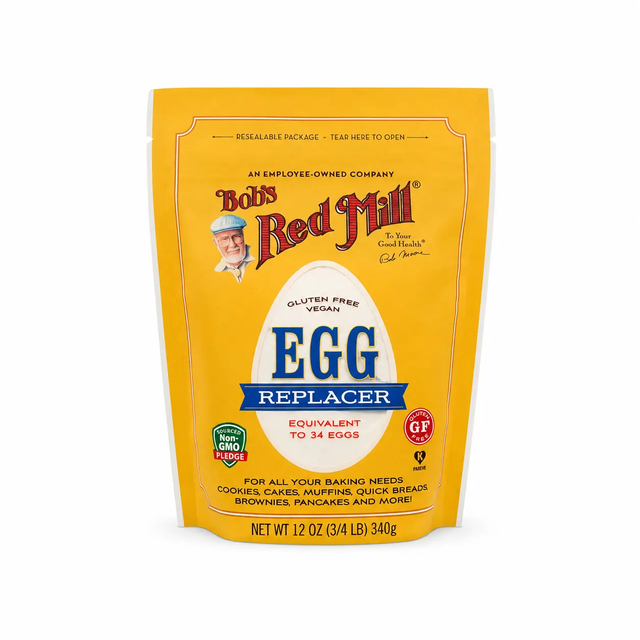
Bob’s Red Mill Egg Replacer — A Starch-Based Mix for Baking
Bob’s Red Mill is one of the most recognised names in gluten free and natural baking, and their Egg Replacer is one of the most widely available powdered substitutes on the market. It is worth understanding exactly what it is, because once you do, you will know precisely when to reach for it and when to leave it on the shelf.
At its core, this is a starch-based mix. The four ingredients are potato starch, tapioca flour, baking soda and psyllium husk fibre. No protein, no fat, no soy, no grains. This is a baking-only substitute. It works well in cakes, muffins, cookies, quick breads, brownies and pancakes. It does not work for scrambles, omelettes, meringues or any preparation where the egg needs to cook into a solid or whip into a foam. 1 tablespoon of powder mixed with 2 tablespoons of water replaces one whole egg.
WHAT IT DOES WELL
Binding and leavening in baked goods. Particularly reliable when replacing more than one egg in a recipe, where single-ingredient substitutes like flax egg can produce a gummy texture.
WHAT IT DOES NOT DO
Scrambles eggs, meringues, emulsification like vegan mayonnaise, or any cooking application outside of baking.
HONEST NOTE
I have never personally used it, simply because I prefer to make this mix myself, combining the individual ingredients. But I know how it works, and I can see the appeal: if you are not yet confident with quantities, having a pre-measured, mix takes all the guesswork out of vegan baking.

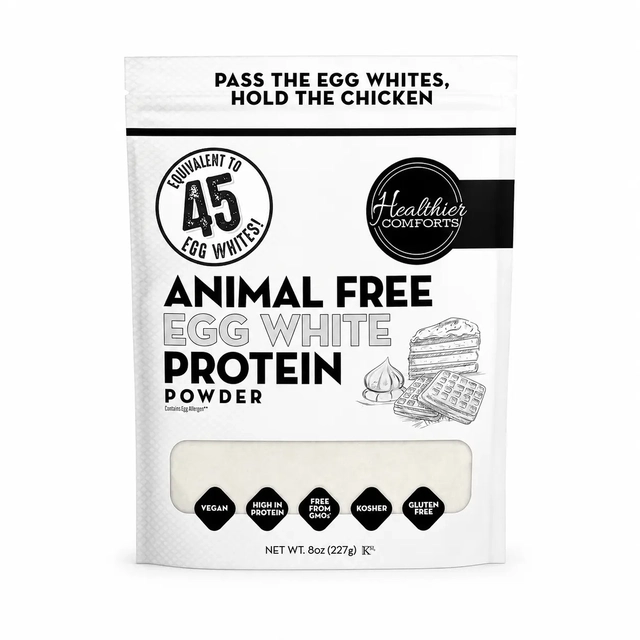
Healthier Comforts Animal-Free Egg White Protein Powder — The Future of Egg Substitution
This is the most technologically advanced product on this list, and the most recent. Launched in December 2025, it sold out almost immediately after generating enthusiastic discussion in vegan communities online. It is worth understanding exactly what makes it different, because it represents something genuinely new.
This is not a plant-based substitute. It is not aquafaba, it is not starch, it is not chickpea water. It is the actual egg white protein — ovalbumin — produced through precision fermentation, without a single chicken involved. What precision fermentation means in practice is this: instead of extracting protein from an egg laid by a hen, scientists programme microorganisms to produce the identical protein through a fermentation process. The result is bio-equivalent to traditional egg white but made entirely without animals. Mix 1 tablespoon (5g) of powder with 2 tablespoons of water to replace one egg white.
WHAT IT DOES WELL
Meringues, macarons, angel food cake, soufflés, mousses, any preparation where egg white performance is critical and aquafaba has previously been unpredictable.
WHAT IT DOES NOT DO
It cannot replace the whole egg, no binding in the way a full egg works in a burger or banana bread, no emulsification for mayonnaise, no scrambled egg experience. It is specifically and exclusively an egg white substitute.
HONEST NOTE
I have not tried this one yet, but it is firmly at the top of my experiment list. What fascinates me is what it represents: the direction that research and food technology are taking when driven by an ethical vision.
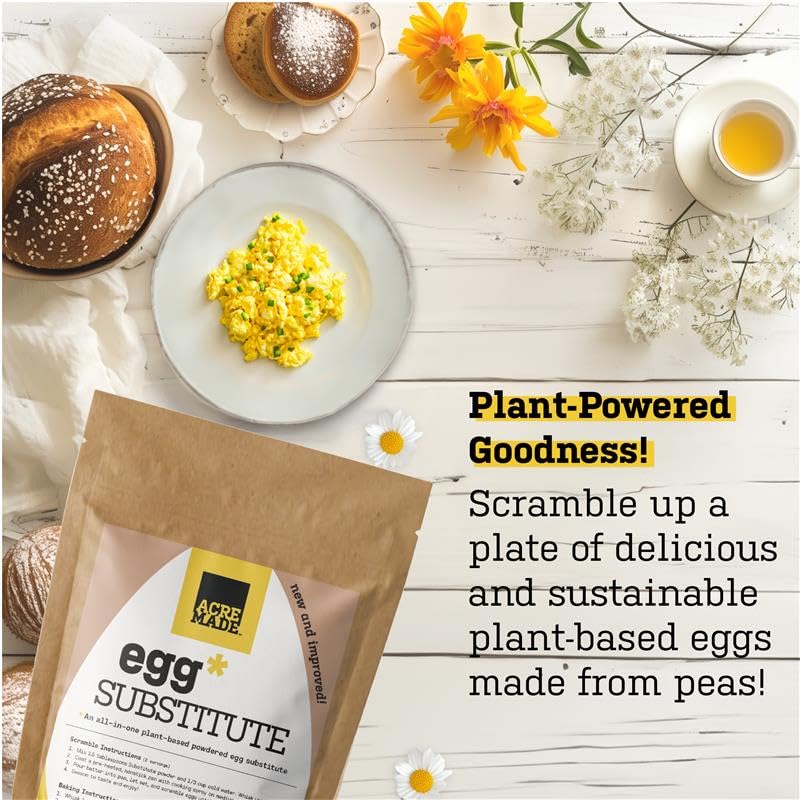
AcreMade — The Powdered Egg Substitute That Also Scrambles
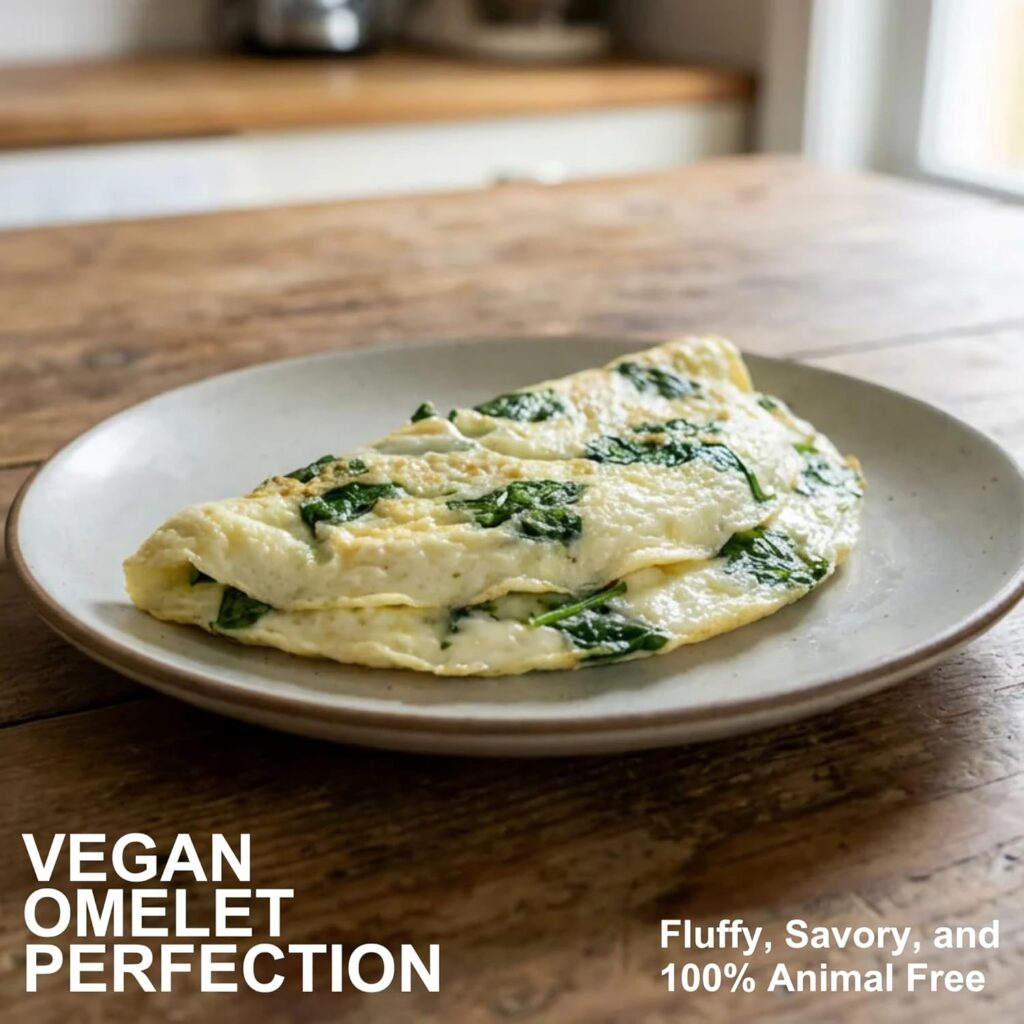
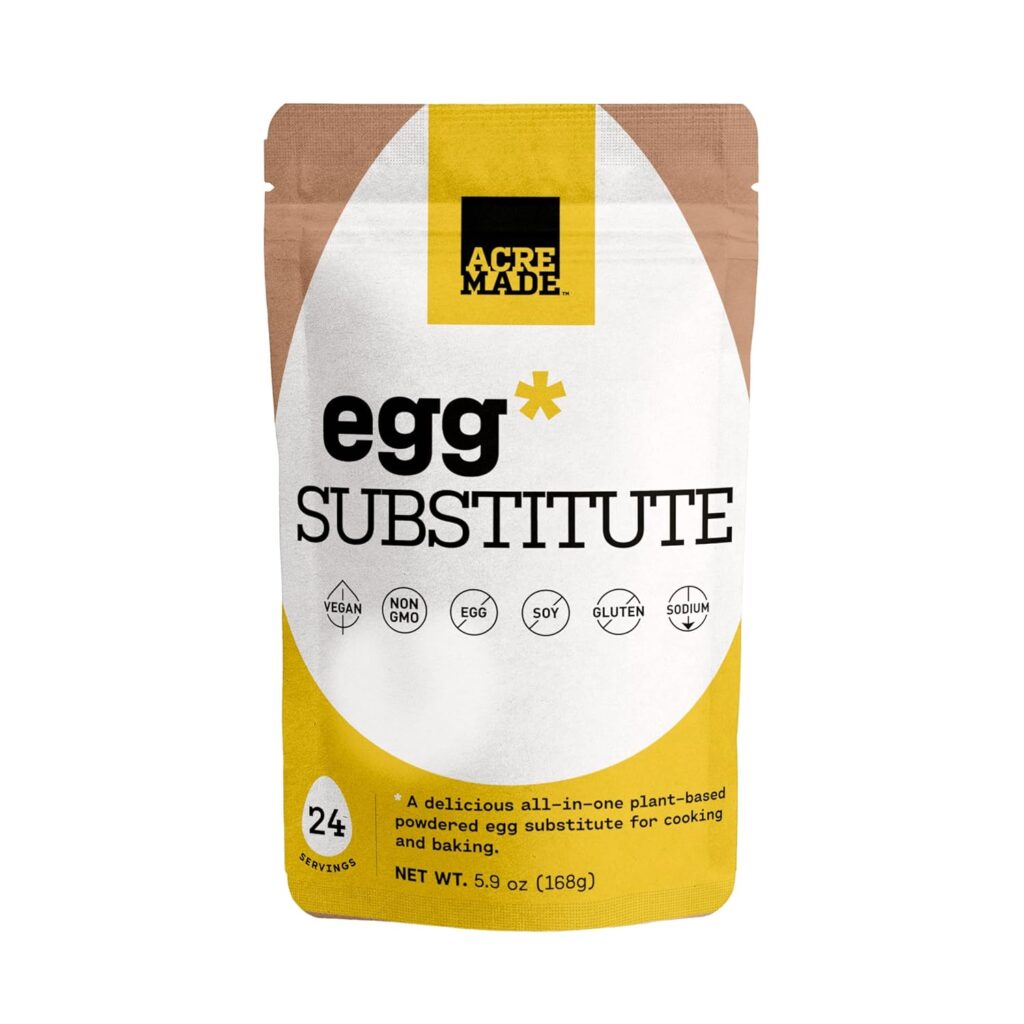
AcreMade is the most versatile powdered egg substitute on this list, and the one that bridges the gap between the two main categories we have covered. Unlike Bob’s Red Mill, which is a baking-only product, AcreMade is designed to work both in baked goods and as a scrambled egg substitute. A dry powder that scrambles. That is genuinely unusual.
The base ingredient is pea protein, yellow field peas grown in the US and Canada, non-GMO, processed in Minnesota. The full ingredient list of the more complete version includes pea protein, lupin flour, upcycled pea starch, gellan gum, methylcellulose, sea salt, turmeric for colour, onion powder and dried yeast. It is more processed than Bob’s Red Mill, but that processing is precisely what gives it the ability to cook like an egg on a skillet.
It is also free from all nine major allergens, no nuts, no egg, no soy, no dairy, no gluten. This makes it one of the most allergy-friendly options on the market, and genuinely useful for households with multiple dietary restrictions. For scrambled eggs, mix 1 tablespoon of powder with 3 tablespoons of cold water.
WHAT IT DOES WELL
Scrambled eggs, omelettes, frittatas, baking, cakes, cookies, muffins, pancakes, brownies. One of the few powdered products that genuinely covers both cooking and baking functions.
WHAT IT DOES NOT DO
It will not whip into meringue peaks or emulsify like an egg yolk. For those functions, aquafaba and soy milk or the other products we listed remain the better choices.
MY HONEST NOTE
I have not tried this specific brand yet, but I have used a similar product and the results were good. The technology works. But the real strength of AcreMade is its allergen-free profile. Someone who cannot eat soy, for example, cannot use tofu for scrambled eggs.
Beyond Cooking: The Vegan Hard-Boiled Egg
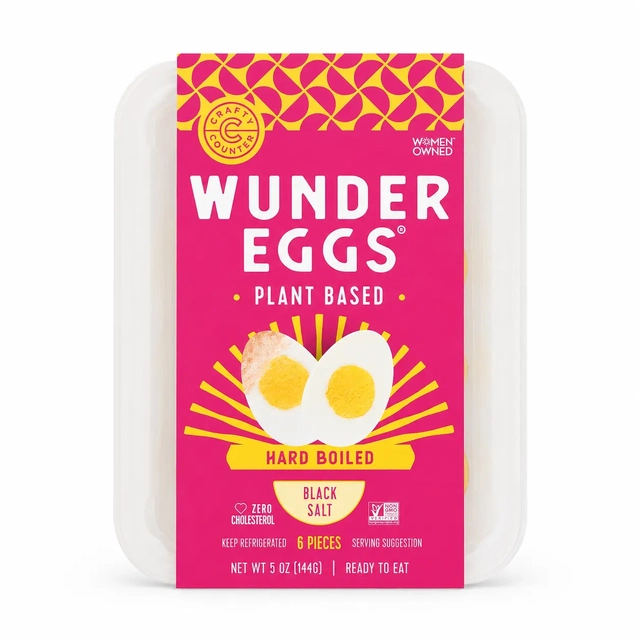
Everything on this list so far has been an ingredient, something you use to cook or bake. WunderEggs is something entirely different: it is a ready-to-eat vegan hard-boiled egg. You open the tray, sprinkle the included sachet of kala namak, and eat it. That is it.
Created by Crafty Counter, an Austin-based women-owned company, WunderEggs are the world’s first whole food, plant-based hard-boiled egg substitute. They are made primarily from almonds, cashews and coconut, with agar (a seaweed-based gelatin) for the white’s structure and konjac for texture, turmeric and annatto for colour, and kala namak for that unmistakable sulphurous egg flavour. The ingredient list is remarkably clean for a product this technically ambitious. The result looks like a halved hard-boiled egg, white and yolk included.
WHAT IT DOES WELL
Eating as a standalone snack, deviled eggs, egg salad, avocado toast topping, cold salads. Any preparation where a hard-boiled egg would be eaten cold, like salads or bowls.
WHAT IT DOES NOT DO
It cannot be used for cooking, baking, scrambling or any hot preparation. This is a cold-eat product only.
HONEST NOTE
I have not tried WunderEggs and, honestly, I probably won’t. Not because I doubt the product: I think it is genuinely ingenious, and I can see how it could help someone transitioning to a vegan diet. But my personal approach to vegan cooking has never been about total replacement. I do not think of it as a cuisine of substitutes, I think of it as a cuisine of creativity.

The Bottom Line: Do You Actually Need Commercial Egg Substitutes?
Personally, I do not think any of the products on this list are strictly necessary for vegan cooking. They are not necessary for creativity, they are not necessary for nutrition, and not having them is not a gap. Vegan cooking does not need them to be complete.
That said, I want to be clear: I am not dismissing them, refusing to use them, or telling you to avoid them. Every single product on this list has been recommended thoughtfully and sincerely. But I do not want to leave you with the impression that vegan cooking is a cuisine defined by what it lacks. It is not. The ingredients exist, they are available, and with creativity and awareness you can rewrite a culinary tradition built on respect, ethics, and yes, love.
What I do believe, strongly, is that it is important, actually, essential, to support the companies moving in this direction. The brands behind these products are building something real: commercial solutions that make plant-based eating more accessible, that promote a healthier and more ethical way of living, and that meet people where they are, including people who do not yet have all the knowledge, the time, or the confidence to do it from scratch.
Keep Exploring: Your Next Steps in Vegan Egg Cooking
Understanding egg substitutes is a journey, not a checklist. If this guide has sparked your curiosity, here is where to go next:
If you want to understand why vegan eggs substitutes can taste like eggs, that sulphurous, distinctive flavour that makes a scramble unmistakable, the answer is a single extraordinary ingredient. Everything you need to know about Kala Namak is here.
If you want to go deeper on how eggs work in cooking and baking, the science behind binding, leavening, emulsifying and every other function, our complete guide to replacing eggs in vegan cooking covers it all, with exact quantities and techniques for every application.
If you want to see all of this in action, start with the recipe that proves it works: our vegan scrambled egg recipe: tofu, kala namak, tahini and a handful of spices that come together into something genuinely convincing.
And if you are building your plant-based kitchen from scratch and want to know exactly what to stock, our vegan pantry guide has everything you need, the essential ingredients, the tools, and the products worth keeping on your shelf.