This article contains affiliate links. If you purchase through them, INUMAMI may earn a small commission at no extra cost to you. We only recommend what we genuinely use and trust and your support means the world to us.
No, vegans do not drink milk that comes from animals. The reason is simple: veganism excludes foods derived from animals.
Plant based milks, however, are a completely different story. Soy, almond, oat, coconut and other non dairy milks can all be part of a vegan diet.
In this guide, you’ll find everything you need to know about veganism and milk. You’ll also be perfectly prepared for that inevitable conversation about why, no, choosing not to drink animal milk really isn’t that extreme.
What Exactly Is Milk, and Why Do We Call Plant Based Milk “Milk”?
Before discussing why vegans don’t drink animal milk, let’s clarify something: what exactly is milk, and why do we use the same word for a liquid produced by a cow and one made from soybeans, almonds or oats?
Biologically speaking, milk is a liquid produced by the mammary glands of mammals to nourish their young. Humans produce milk, cows produce milk, and so do goats, sheep and other mammals. But the word milk has a much broader history than its biological definition might suggest.
The English word comes from the Old English meoluc, and although it originally referred to animal milk, it has also been used to describe milky plant liquids since at least the 13th century.
And here’s something particularly interesting: almond milk is not a modern vegan invention. It was already widely used in medieval cooking, especially during religious fasting periods when animal products were restricted. Historical cookbooks contain recipes using almond milk centuries before plant based diets became a contemporary movement.
So why is almond milk called milk? Quite simply, because of its appearance, consistency and culinary uses. When almonds are blended with water and strained, they produce a pale, milky liquid that can be used in many of the same ways as dairy milk. The same principle applies to soy milk, oat milk and other plant based alternatives.
The important distinction is where the milk comes from, not simply what we call it. And for vegans, that distinction makes all the difference.
Why Don’t Vegans Drink Cow’s Milk? The Ethics Behind Dairy Production
One of the most common misconceptions about veganism is that avoiding meat makes sense, but avoiding milk is somehow extreme. After all, cows produce milk, and collecting it doesn’t necessarily mean killing the animal. So what’s the problem?
The problem is that milk production is far from the harmless process many people imagine.
Just like humans and other mammals, cows produce milk after giving birth. To maintain commercial milk production, dairy cows are repeatedly bred and give birth to calves throughout their productive lives. In conventional dairy farming, calves are generally separated from their mothers shortly after birth. This allows the milk produced by the cow to be collected for human consumption, while calves are raised separately. Isn’t this a valid reason not to drink milk? I personally believe it is.
And this isn’t simply an argument made by animal rights organisations.
According to the European Food Safety Authority (EFSA), limited contact between cows and their calves can negatively affect animal welfare. Its 2023 scientific assessment found that calves separated from their mothers lose opportunities for natural suckling and social development, and may experience isolation stress depending on how they are raised.
There are other concerns, too. Dairy cows can experience health problems such as mastitis, lameness and metabolic disorders, while animals who are no longer economically productive are commonly removed from the dairy herd, often for slaughter.
For vegans, the ethical question goes beyond whether an animal is killed to produce a particular food. It is also about whether animals should be bred, separated from their offspring and used for human consumption when alternatives are available.
And that is why dairy milk, regardless of whether it comes from cows, goats or sheep, is not considered vegan.
The same applies to honey and silk. These are not necessarily products that require an animal to be killed, but they are products for which animals are denied respect and subjected to exploitation and abuse throughout their lives. And sometimes, a lifetime of suffering can be even worse than death itself.
Is Cow’s Milk Actually Healthy? Do We Really Need It?
For decades, we’ve been told that drinking milk is essential for strong bones, healthy teeth and adequate calcium intake. Milk has become so closely associated with good nutrition that the idea of removing it from our diets can seem almost irresponsible.
But here’s something worth knowing: humans do not actually need to drink cow’s milk to be healthy.
According to researchers at Harvard T.H. Chan School of Public Health, dairy milk is not necessary for people who follow a balanced diet. While it contains valuable nutrients, including calcium and protein, these nutrients can also be obtained from other foods.
And What About the Famous Relationship Between Milk and Strong Bones?
Research has not consistently demonstrated that drinking more milk reduces the risk of hip fractures. Calcium is certainly essential for bone health, but cow’s milk is far from its only source. Calcium-set tofu, fortified plant milks, leafy green vegetables and other plant foods can all contribute to meeting our daily requirements.
Can Humans Actually Digest Cow’s Milk?
There’s another fascinating fact: approximately 68% of the world’s population has some degree of lactose malabsorption, according to a systematic review published in The Lancet Gastroenterology & Hepatology.
This means that most adults worldwide have a reduced ability to digest lactose, the natural sugar found in mammalian milk. However, not everyone with lactose malabsorption experiences symptoms.
What Do Vegans Drink Instead of Milk?
I’ve never eaten meat in my life, but I was vegetarian from birth until I eventually became vegan. Why? Because for a long time, I genuinely believed that milk and dairy products didn’t involve animal exploitation. I thought they were harmless, something animals naturally produced and that we could consume without causing them any suffering.
It was the 1990s and early 2000s. Information wasn’t nearly as accessible as it is today, or at least it wasn’t to me. I didn’t have anyone to guide me, explain how the dairy industry worked or encourage me to question what I had always believed.
Then, one day, I came across the right information, started reading, and something just clicked. I still remember the day I drank my very last cappuccino with cow’s milk. And then came the obvious question: Now what?
What was I supposed to drink instead? What would I put in my coffee? How would I make the recipes I had always loved? As it turned out, that question opened the door to an entirely new world of possibilities. There were so many alternatives to discover, ingredients to experiment with and new ways of cooking that I had never even considered before.
Plant Based Milk Alternatives: More Choices Than You Might Think
Today, the world of plant based milk is incredibly diverse. You can find alternatives made from soybeans, almonds, oats, rice, coconuts, cashews, hazelnuts, peas and even hemp seeds. And that’s just the beginning.
What makes these alternatives particularly interesting is that they’re not all trying to imitate cow’s milk. Each has its own flavour, consistency, nutritional properties and culinary potential. Some are naturally creamy, others are lighter, some are particularly rich in protein, and others work beautifully in desserts or coffee.
You can find most of them in supermarkets, often in unsweetened, flavoured or fortified versions. And if you enjoy experimenting in the kitchen, many can also be prepared at home with just a few ingredients.
The important thing to remember is that plant based milks are not interchangeable in every recipe. Choosing the right one can make a real difference to the final result. The same principle applies to other animal derived ingredients. As we’ve explored in our guides to vegan egg substitutes and vegan butter alternatives, replacing an ingredient isn’t always about finding a single perfect substitute.
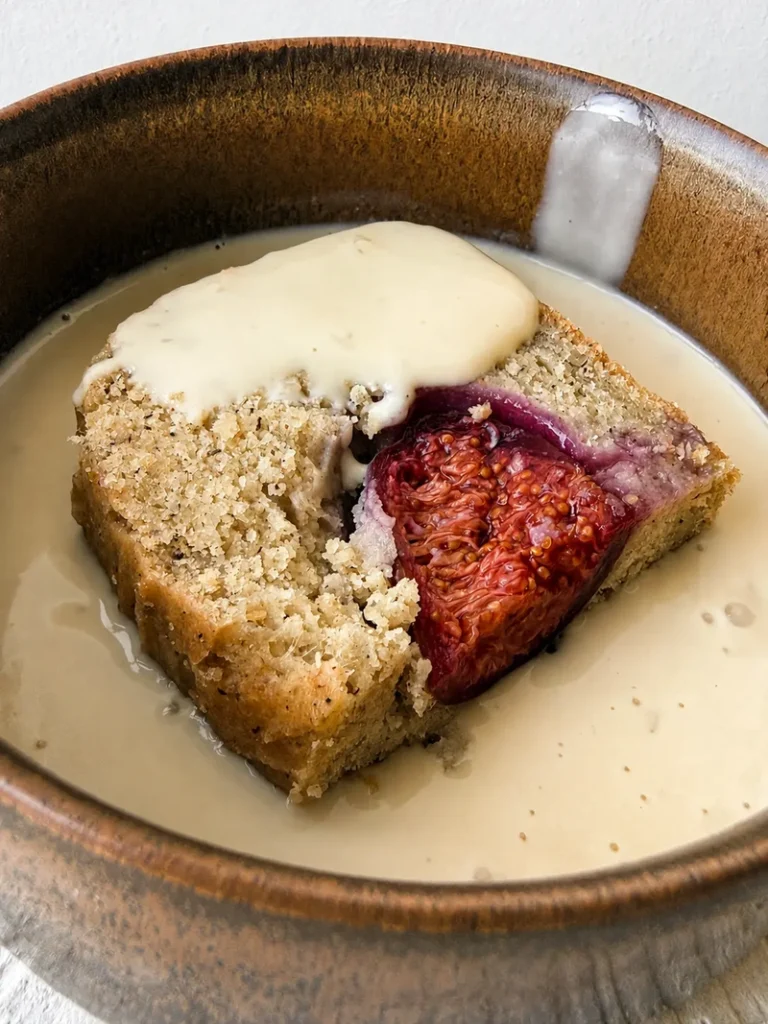
In the photo above, you can see a slice of fig bread served with vegan crème anglaise made with soy milk. Give it a try, and you’ll see for yourself just how little we need animal milk in our kitchens!
Types of Plant Based Milk: A Complete List
You might be surprised by just how many types of plant based milk exist. While soy, almond and oat milk are probably the most familiar, there’s an entire world of alternatives made from nuts, seeds, grains and legumes. Some have been used in traditional cuisines for centuries, while others are relatively recent additions to supermarket shelves.
Here are some of the most common types of vegan milk, along with a few less familiar alternatives worth discovering.
- Soy Milk: Made from soybeans, naturally rich in protein and one of the most versatile dairy alternatives. Excellent for coffee, sauces, baking and desserts.
- Almond Milk: Light, delicate and slightly nutty. Popular in smoothies, breakfast bowls and desserts.
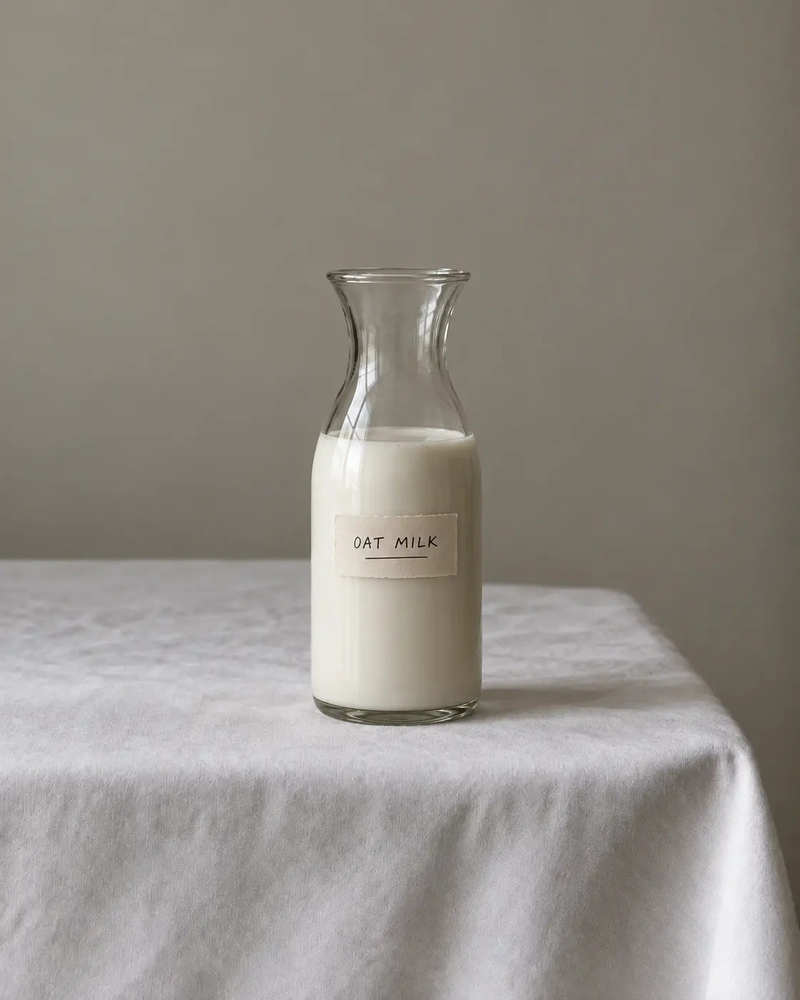
- Oat Milk: Naturally mild, slightly sweet and often creamy. Particularly popular for coffee, lattes and baking.
- Coconut Milk: Available as rich canned coconut milk or lighter coconut drinks. Wonderful for curries, creamy sauces and tropical desserts.
- Rice Milk: Light, naturally sweet and relatively thin in consistency. Often used in drinks, cereals and simple desserts.
- Cashew Milk: Smooth and creamy, with a delicate flavour. Particularly useful for creamy sauces, soups and desserts.
- Hazelnut Milk: Distinctively nutty and aromatic. Especially delicious in coffee, hot chocolate and chocolate based desserts.
- Quinoa Milk: Made from quinoa, with a mild, sometimes slightly earthy flavour. An alternative to traditional grain based milks.
- Spelt Milk: Made from spelt, with a naturally sweet, cereal-like flavour. Suitable for some drinks and baking, but not gluten free.
- Pea Milk: Made from pea protein, generally offering a higher protein content than many nut or grain based alternatives. A useful everyday option.
- Hemp Milk: Made from hemp seeds, with an earthy, slightly nutty flavour. Contains unsaturated fats and works well in smoothies and breakfast bowls.
- Macadamia Milk: Delicate, buttery and smooth. A lovely option for coffee, desserts and creamy drinks.
- Pistachio Milk: Rich in flavour with a distinctive nutty character. Particularly interesting for desserts, coffee and sweet recipes.
- Walnut Milk: Slightly earthy, with a characteristic walnut flavour. Works beautifully in smoothies, breakfast recipes and desserts.
- Flaxseed Milk: Made from flaxseeds, usually light in texture and relatively mild in flavour. An alternative for those avoiding soy and nuts.
- Sesame Milk: Made from sesame seeds, with a rich, slightly bitter and nutty flavour. Particularly interesting in savoury preparations and certain desserts.
- Potato Milk: A newer commercial alternative made using potatoes and other ingredients. Generally mild, with a texture that varies depending on the formulation.
- Buckwheat Milk: Made from buckwheat, which is naturally gluten free despite its name. Slightly earthy and particularly interesting for breakfast recipes.
FAQ’s
Yes, many vegetarians drink cow’s milk and consume dairy products such as cheese, yogurt and butter. This is particularly true for lacto vegetarians and lacto ovo vegetarians. Unlike vegans, vegetarians generally exclude meat and fish but may still consume certain animal derived products.
No, traditional cheese, yogurt, butter, cream and other dairy products are not vegan because they are made from animal milk. However, there are plenty of plant based alternatives made from ingredients such as cashews, soybeans, almonds and coconut.
No, lactose free cow’s milk is not vegan. Although the lactose has been broken down or removed to make it easier to digest, the milk still comes from an animal. Lactose free and dairy free are two different things, and only the latter indicates that a product contains no dairy ingredients.
Absolutely! Both almond milk and soy milk are plant based and suitable for a vegan diet, provided they contain no animal derived additives. Soy milk is particularly useful for its protein content, while almond milk is generally lighter and has a delicate, nutty flavour.
Under the usual definition of veganism, no. Even if a cow is personally cared for and treated kindly, consuming her milk still involves using an animal and her reproductive processes to obtain food. Veganism seeks to avoid animal exploitation as far as possible and practicable, regardless of whether the milk comes from a large commercial farm or a privately owned animal.
Not necessarily. The statement may contain milk is generally an allergen precaution indicating possible cross contact during manufacturing, rather than milk being deliberately added as an ingredient. Some vegans choose to consume these products, while others prefer to avoid them. Always check the actual ingredient list to determine whether dairy has been intentionally included.
Yes, conventional plant based milks made from soy, almonds, oats, rice, coconut and other plants are naturally lactose free because lactose is a sugar found in mammalian milk. However, lactose free doesn’t automatically mean nutritionally equivalent to dairy milk, so it’s worth checking the protein content and whether the product is fortified with calcium and vitamins. I have written a complete guide about Dairy Free and Vegan Milk, you can read it to understand the difference between dairy free and plant-based.