Tofu is a fantastic ingredient, not just for its nutritional profile, but above all because it is like a blank canvas. A neutral, protein-rich base with almost no flavour of its own that can become whatever you want it to be. What most people consider a downside — its lack of taste — is actually the very reason it is one of the most used ingredients in vegan cooking. That neutrality is what allows for enormous creativity across an extraordinary range of recipes.
There are many ways to transform tofu, and marinating is one of the most important and most widely used. In this guide you will learn how to marinate tofu properly, the best practices to follow, and the techniques that do the most justice to this remarkable ingredient.
What Is Marinating and Why Does It Work So Well with Tofu
Marinating is an ancient technique that comes from far back, from civilisations like the Phoenicians and the Greeks, and was originally used to preserve ingredients when refrigeration was not an option. Now that we no longer need to keep food for months without cold storage, marinating has become a purely gastronomic technique. But it still follows the same chemical logic it always did: an acidic component to tenderise, a fat to protect and lock in flavour, and aromatics to add taste.
Before you can marinate tofu properly, one step is not just recommended: it is essential: the tofu must be pressed. You can use a tofu press, or if you do not have one, I have written a complete guide on how to press tofu without a press. The reason is simple: tofu is full of water, trapped between its fibres. By pressing it and forcing that water out, you make the tofu porous and ready to absorb the marinade. Without pressing, the water already occupying those spaces leaves no room for the flavour to enter.
Once pressed, the tofu is ready. And this is where the chemistry becomes interesting. When you submerge pressed tofu in a marinade, two physical forces activate simultaneously: capillarity, which draws the liquid into the microscopic channels left empty by pressing, and diffusion, which pushes flavour molecules, sugars, aromatics, salts, to move from where they are concentrated in the bowl to where there is none at all, deep in the heart of the tofu. The result is a block that does not just taste of marinade on the surface, it is flavoured all the way through.
Marinating Is Not Just a Seasoning — It Is a Pre-Cooking Technique
Marinating is, in effect, a pre-cooking technique, not simply a condiment. It is a method most associated with meat, but tofu actually lends itself to it even better. If you have pressed it well and removed the original water, the marinade will not stop at the surface, it will travel by capillarity and diffusion all the way to the heart of the block. Something that, with meat, never truly happens.
How to Marinate Tofu: The Five Elements of a Perfect Marinade
To marinate tofu well, you need to start from a few simple rules that serve as a foundation, one you can then build on creatively. There are five key elements, and if they are respected, the result will always be excellent.
1. Acid
The acidic component of a tofu marinade serves two main purposes: it opens up the microscopic pores of the tofu, creating the perfect space for all the other flavours to enter, and it balances the overall taste by counteracting the slight bitter note that tofu naturally carries. My favourite options include rice vinegar and other mild vinegars, or citrus, lemon or lime work particularly well.
2. Salt and Umami
The savoury component does more than enhance flavour, it also drives osmosis, pushing the liquids to travel toward the centre of the block, which would otherwise remain bland on the inside. The ideal choice here is something that is both savoury and umami-rich.
Miso and tamari are my go-to options because they add depth, complexity and that characteristic savoury note that can turn a good marinade into a truly satisfying one. You can explore more umami-rich ingredients in my guide to vegan umami foods, while my in-depth tamari guide explains how to use tamari, how it differs from soy sauce, and what to look for when choosing a good bottle.
3. Sweetness
Sweetness is not one of the pillars of classic marinades, but it is strongly recommended when marinating tofu, primarily because it helps the tofu caramelise beautifully during cooking, creating that golden, slightly sticky exterior that makes it so satisfying to eat. My preferred sweetener is agave syrup, but maple syrup works just as well.
4. Aromatics
This is where you give the marinade its personality. Since tofu is essentially flavourless and has been well prepared to receive the marinade, it will absorb aromatics super well. You can build a complex mix or choose one strong protagonist. My personal favourite combination is garlic and grated ginger, but powdered spices like paprika, cinnamon, or fresh herbs like chives or thyme all work beautifully.
5. Fat
Oils like sesame — strong and distinctive — or more neutral options both work here. The important thing is to use fat sparingly, or to add it toward the end of the marinade rather than at the beginning. This is because fat’s primary role is to seal and ensure a good cook, but in the marinade itself, that sealing effect can actually act as a barrier, preventing the other components from penetrating the tofu. Less is more.
How Much Marinade Do You Need? Quantities and Proportions
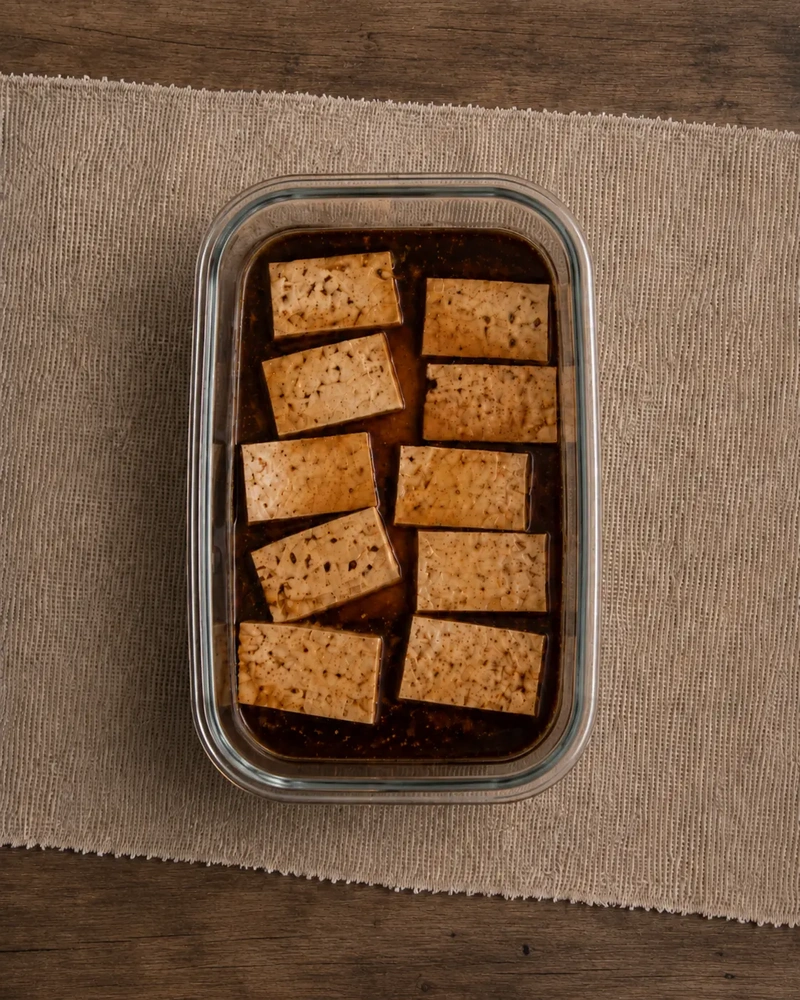
For every 100g of tofu, you need approximately 3 to 4 tablespoons of liquid in total, which is enough to coat and marinate the block thoroughly without waste. Scale these proportions up or down depending on the quantity of tofu you are working with, the ratios stay the same regardless of size. Based on the five elements we covered above, here are my standard proportions that work consistently well.
The base formula for 100g of tofu:
2 tablespoons — savoury component (soy sauce or tamari): the engine of absorption, drives osmosis and flavour into the centre of the block
1 tablespoon — acid (lime juice, lemon juice or rice vinegar): opens the pores and balances the flavour
½ teaspoon — sweetness (maple syrup or agave): adds caramelisation during cooking
½ teaspoon — fat (toasted sesame oil or olive oil): add this last, not at the beginning, to avoid creating a barrier that blocks the other components from penetrating
Aromatics to taste (garlic powder, grated ginger) :approximately 1 teaspoon total, or more depending on how bold you want the flavour
How to Marinate Tofu: The Methods and What Makes Each One Different
The marinade itself, its acidity, its salt, its aromatics, is only half the equation. The other half is the method: how the tofu comes into contact with the marinade, how long it stays there, and what conditions allow the flavour to travel as deeply as possible into the block.
What needs to happen is simple: the marinade needs to surround the tofu completely and stay in close contact with it for long enough to allow capillarity and diffusion to do their work. Any air between the tofu and the liquid slows that process down. Any movement or agitation speeds it up. The more surface area of the tofu is in direct contact with the marinade, the deeper and more even the result.
This is why the method you choose matters. A bowl with the tofu loosely submerged and a lot of air above it will give you a different result from a sealed bag with all the air pressed out, which will give you a different result again from a vacuum seal. Each method creates a different level of contact, pressure and absorption, and understanding that is what allows you to choose the right one for the time and tools you have available.
Regardless of which method you choose, the process is always the same: combine your marinade ingredients, add the pressed tofu, leave it to marinate, and cook. What changes between methods is how efficiently the flavour travels, and how much effort you want to put in.
The Airtight Container Method — Simple, Effective, No Special Equipment
The simplest method and the one that requires nothing beyond a container with a lid. Place the pressed tofu in the container together with all your marinade ingredients, close the lid and shake well. That initial shake is important, it ensures the marinade coats every surface of the tofu from the very first moment. From here, you have two options depending on when you plan to cook:
If you are cooking within a couple of hours, leave the container at room temperature for a minimum of 30 minutes, though longer is always better. If you are preparing it the night before or several hours ahead, the fridge is the right choice.
One practical tip that makes a real difference: at the halfway point: after approximately 15 minutes if you are doing a short marinade, flip the container upside down and give it another gentle shake. The marinade naturally pools at the bottom over time, which means the tofu on top receives less contact. Flipping it redistributes the liquid and ensures every piece is evenly coated all the way through.
The Vacuum Seal Method — Professional Results at Home
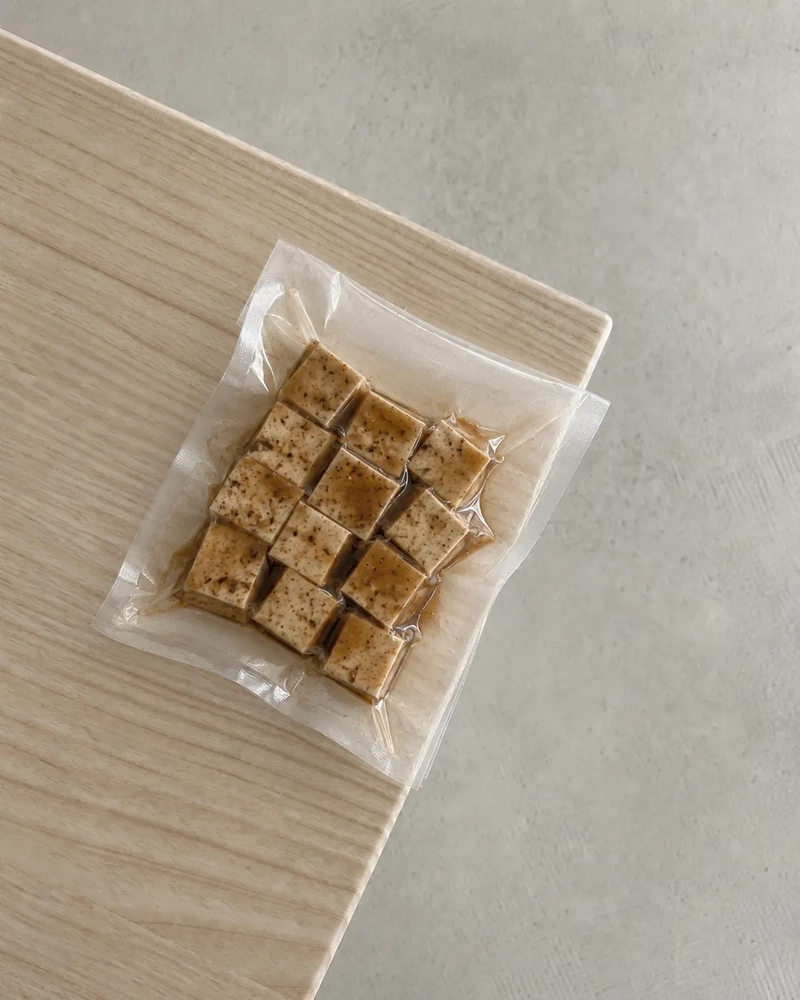
In professional kitchens, this technique is called negative pressure marinating , which sounds complex and reserved for specialists. In practice, I do it regularly at home with a relatively inexpensive sealing machine I bought specifically to try it out. If you are curious about marinating and want to take it further, it is worth the investment.
The advantage is speed. When the machine extracts the air from the bag, the pores of the tofu open to their maximum capacity, creating the ideal conditions for the marinade to penetrate deeply and evenly in a fraction of the time any other method requires.
The process is straightforward: once you have pressed and cut your tofu, place it in the vacuum bag together with all your marinade ingredients. Seal the bag, then massage it gently to distribute the marinade evenly before the vacuum takes effect. Ten minutes at room temperature is all you need even if I personally prefer fifteen, but ten is already enough to achieve a result that would take a standard container method at least an hour to replicate. Open, and cook.
The Zip-Lock Bag Method — How to Get Vacuum Results Without a Machine
I have not personally tried this method, but the chemistry behind it is sound, and the principle is clear enough that I can explain it with confidence. If you have tried it and want to share your results, please share it in the comments section. The idea is simple: a zip-lock bag allows you to remove most of the air manually before sealing, creating a semi-vacuum that increases the contact between the marinade and the tofu significantly more than an open container would. No machine required, just your hands.
Place the pressed and cut tofu in the bag together with all your marinade ingredients. Before sealing completely, press out as much air as possible: work from the bottom of the bag upward, pushing the air toward the opening, then seal it shut at the last moment. What you are left with is a bag where the marinade is in close, even contact with every surface of the tofu, with minimal air to slow the absorption down.
Massage the bag gently after sealing to distribute the marinade evenly. Leave it at room temperature for 30 minutes for a quick result, or refrigerate for a few hours or overnight for maximum flavour.
The Freezer Marinade Method — The Happy Accident That Became My Favourite Technique
This is a known technique in professional cooking, but I arrived at it entirely by accident. I had been experimenting with freezing tofu to remove moisture and improve texture, as I explain in detail in my guide to pressing tofu without a press. One day I froze it with the marinade already in the bag: not intentionally, but because I had forgotten to press it first, added the marinade anyway, and thought: well, what else am I going to do now?
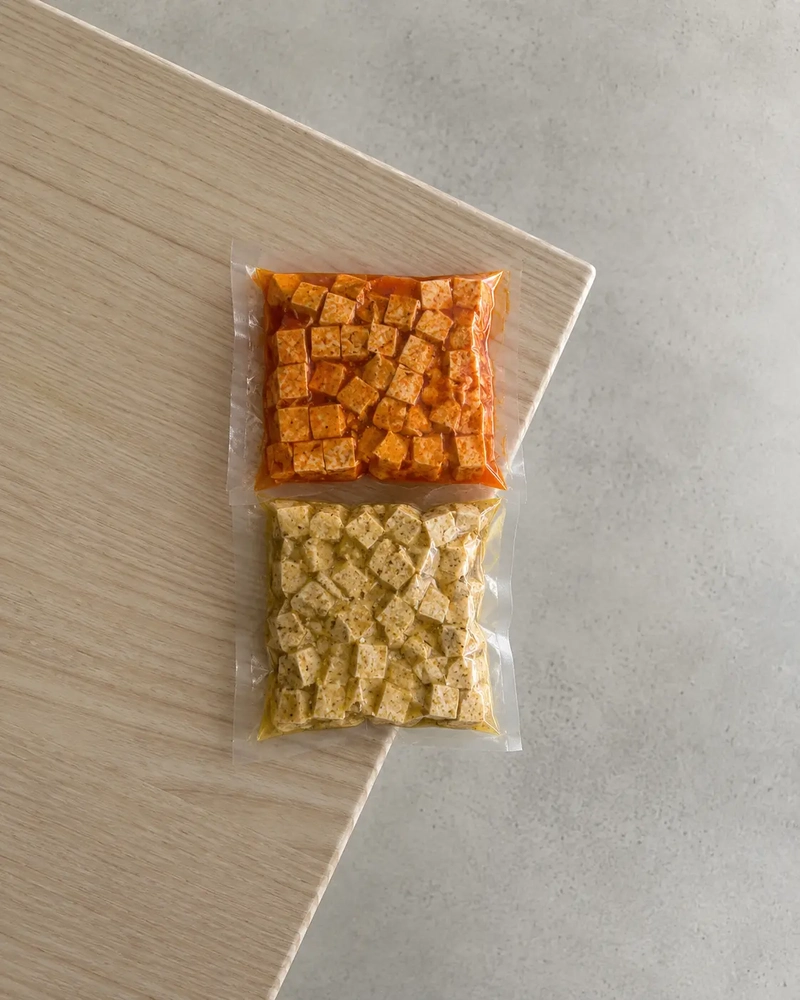
The result was unexpectedly excellent. So good, in fact, that it became a method I now use deliberately. The process could not be simpler: cut the tofu into cubes without pressing it first, add your marinade ingredients to a freezer bag, seal it and put it in the freezer for one night or up to 24 hours. Then thaw it in the fridge and cook.
The logic behind it is straightforward. As the tofu freezes, ice crystals form inside and break through the internal protein structure, the same process described in the freezer pressing method. The marinade freezes around the tofu simultaneously. When everything thaws, the liquid is reabsorbed directly into the channels that the ice crystals have opened up. The marinade does not just coat the surface: it travels deep into a structure that has been physically opened up to receive it.
The advantages are threefold: no pressing required, no equipment needed, and the result is a tofu with a deeper, more even flavour and a chewier, meatier texture than almost any other method produces. The only thing it requires is time but the freezer does all the work for you.
The Warm Marinade Method – When You Are Short On Time
If you are short on time, or if you do not have any tools available, another quick method is warm marinating. Personally, this is not a technique I use often, but it can be useful in certain situations.
The idea is simple: gently warm the marinade until it is just lukewarm, no more than that, otherwise you may start to pre-cook the tofu. Then pour it over the tofu and let it marinate for about 15 minutes. The gentle heat helps the tofu absorb the flavors more quickly, making this a useful option when time is limited. It is not a classic marinating method, but it does work.
That said, I do not find the flavor to be as deep or as lasting as with the other methods. The marinade does not penetrate quite as intensely, but it is still worth considering when you are in a hurry, especially if the recipe calls for the tofu to be torn by hand. Smaller, irregular pieces expose more surface area, which allows them to absorb the marinade more easily. Once the tofu has marinated, you can cook it using your preferred method.
Using the Marinade When Cooking Tofu
If you have leftover marinade after marinating the tofu, you can use it during cooking. Of course, this depends on the type of recipe you are making.
For everyday cooking, my most used method is pan-frying. Usually, before adding the tofu to the pan with a little oil, I coat it lightly in starch. This helps the tofu become crisp on the outside. Then, during the last 2 or 3 minutes of cooking, I pour in the remaining marinade. The heat will evaporate the water, while any sugars in the marinade, such as maple syrup, will begin to caramelize. At the same time, the starch left on the surface of the tofu will bind with the liquid, thickening it almost instantly into a creamy sauce that coats each cube.
I do something similar when baking tofu in the oven. In this case, I pour the leftover marinade over the tofu halfway through cooking. This helps create layers of flavor and forms a light crust on the surface.
For braised dishes, soups, or curries, I usually brown the tofu first, then add the vegetables, and finally pour in the marinade together with the cooking liquid, such as coconut milk. The marinade dilutes into the stew or sauce, spreading its flavor through the dish without the need for much extra seasoning.
3 Simple Tofu Marinade Ideas
Marinating tofu is an art. You have a blank canvas in front of yo, the tofu, and a palette divided into sections: the pillars of flavor and the right proportions. If you do not remember them, go back and read the previous section before starting.
Then you have an endless range of colors available: the ingredients. What remains is the freedom to experiment.
Below are my top 3 tofu marinades, the ones I use most often in my everyday cooking. Start with these, then use them as a base to create your own combinations and share them in the comments below!
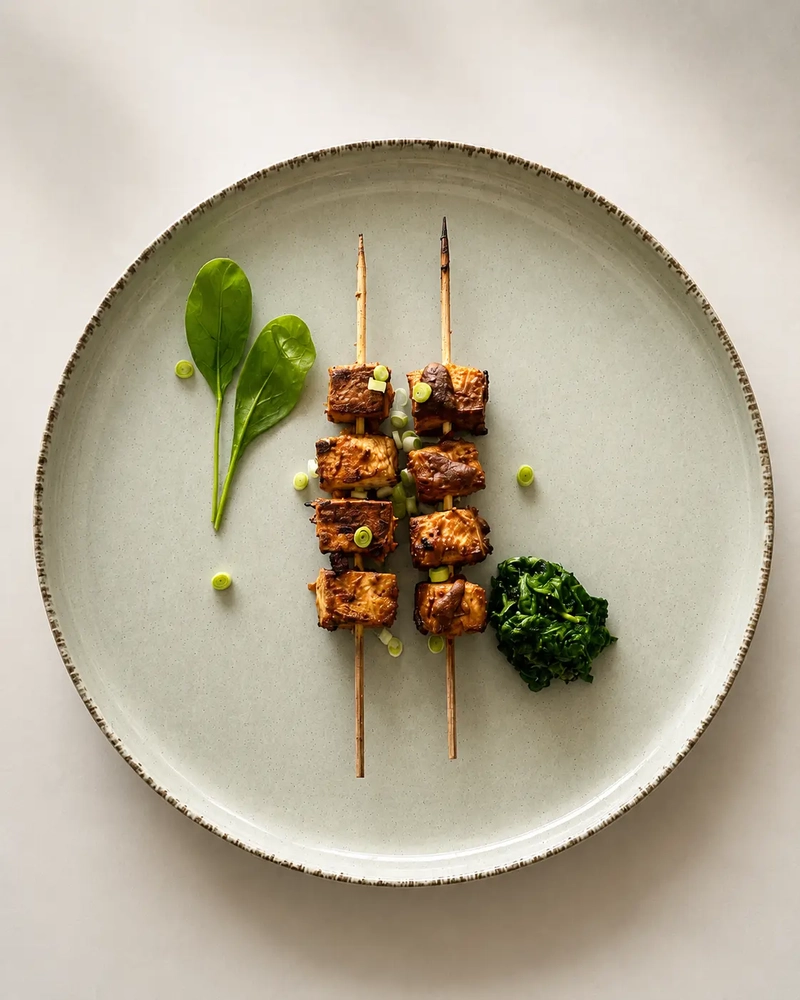
Tamari, Lime & Ginger Tofu Marinade
This marinade is deep, savory, and bright at the same time. It is a beautiful marinade for tofu that will be pan-fried, baked, or cooked until lightly caramelized, especially when you want something bold but still balanced. This marinade is especially good for tofu that will be pan-fried, baked, or cooked until lightly caramelized.
For this marinade, mix together:
- 2 tablespoons tamari — adds saltiness, depth, and a strong umami base.
- 1 tablespoon lime juice — brings acidity and freshness.
- ½ teaspoon date syrup — adds a soft sweetness and helps with caramelization.
- ½ teaspoon sesame oil — gives roundness and a slightly nutty aroma.
- 1 teaspoon mixed aromatics — use a mix of freshly grated black garlic, fresh grated ginger, and cumin powder for warmth, depth, and an earthy note.
Orange, Miso & Paprika Tofu Marinade
This marinade is warm, savory, and slightly sweet, with a citrusy note that makes the tofu taste brighter and more layered. This marinade is especially good for baked tofu, pan-fried tofu, or tofu served with roasted vegetables, rice bowls, or warm grain dishes.
For this marinade, mix together:
- 1 tablespoon tamari — adds saltiness and umami.
- 1 tablespoon miso paste — gives depth, richness, and a savory fermented flavor.
- 1 tablespoon orange juice — brings brightness and a soft citrus note.
- ½ teaspoon agave syrup — balances the saltiness and helps the marinade caramelize.
- ½ teaspoon olive oil — adds roundness and helps the tofu brown.
- 1 teaspoon paprika — adds warmth, color, and a lightly smoky note if using smoked paprika.
- ¼ teaspoon cinnamon — gives a subtle warm background note.
- A pinch of ground coriander — adds a delicate citrusy aroma that pairs beautifully with orange and miso.
Spicy Coconut, Lime & Chili Tofu Marinade
This marinade is spicy, bright, and aromatic, with a soft tropical note. This marinade works especially well when the tofu is pan-fried until golden, then finished with the leftover marinade in the last few minutes of cooking.
For this marinade, mix together:
- 1 tablespoon tamari — adds saltiness and umami.
- 1 tablespoon lime juice — brings acidity, freshness, and brightness.
- 1 tablespoon full-fat coconut milk — adds creaminess, softness, and a subtle tropical note.
- ½ teaspoon agave syrup — balances the acidity and helps with caramelization.
- 1 teaspoon fresh grated ginger — adds warmth and a fresh spicy note.
- ½ teaspoon chili flakes or fresh chopped chili — brings heat; adjust depending on how spicy you want it.
- A pinch of ground coriander — adds a delicate citrusy, aromatic note.
- A pinch of turmeric — gives color and a warm earthy background.
FAQ’s About Marinating Tofu
Marinating tofu becomes much easier once you understand a few simple principles: time, texture, pressing, and cooking method. These answers cover the most common questions ( I hope!), so you can adapt the marinade to the tofu you are using and the dish you want to create.
After marinating, tofu can be pan-fried, baked, air-fried, grilled, or added to soups and curries. For a crispier result, remove the tofu from the marinade, coat it lightly with starch, and cook it until golden. You can then add the leftover marinade during the last few minutes of cooking to create a quick glaze or sauce.
For stir fry, cut the tofu into cubes or tear it into small irregular pieces so it has more surface area to absorb flavor. Use a marinade with a balance of saltiness, acidity, a little sweetness, and aromatics. After marinating, cook the tofu separately until golden, then add it back to the stir fry at the end so it keeps its texture.
To bake marinated tofu, place the tofu pieces on a lined baking tray, leaving some space between them. Bake until the edges are firm and lightly golden, turning the pieces halfway through if needed. You can brush or pour a little leftover marinade over the tofu halfway through cooking to build more flavor and help create a light crust.